When the Permanent System Is a Year Away, the Temporary One Has to Work
Fire protection requirements don’t begin at occupancy.
They begin the day the first hazard is introduced to a site — and on active construction sites, that can be well before a permanent system is anywhere close to operational.
When a major data center project faced a critical gap in life safety coverage with the permanent fire alarm system more than a year from completion, the project team needed a compliant, engineered solution that could be deployed immediately.
ACS Group partnered with Space Age Electronics (SAE) and JM Electronic Engineering (JMEE) to design and implement a temporary fire protection system that met every requirement set by the Authority Having Jurisdiction (AHJ) — and did it in five days.
The challenge was significant.
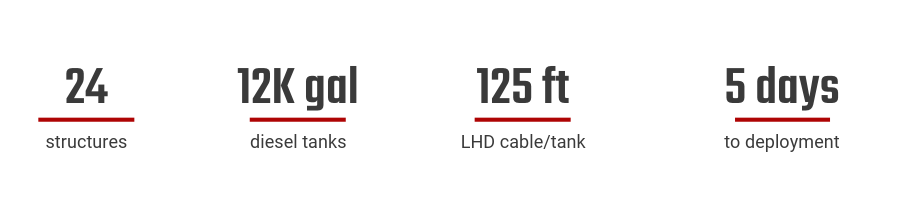
- The site included 24 modular utility structures, each a four-story stack housing a 12,000-gallon diesel fuel tank, an electrical enclosure, a generator floor, and a chiller.
- The AHJ required immediate notification capabilities before generators could be fueled and tested.
- The Fire Marshal added a further requirement: any temporary system had to include precise heat monitoring, given the high-hazard classification of the fuel tanks.
Standard solutions weren’t built for this environment.
Hard-wiring a permanent-style system across the 24 structures would have required significant labor and materials, adding time that the construction schedule couldn’t absorb. Other wireless options suffered from range and interference issues inside the metal structures.
The solution was SAE’s Beacon WES (Wireless Evacuation System) paired with Linear Heat Detection (LHD). ACS Group provided the fire protection engineering expertise to define the technical requirements, evaluate available options, and guide the team toward a compliant detection strategy.
Approximately 125 feet of LHD cable was installed above each of the 24 tanks in a zigzag pattern, connecting wirelessly to the WES network and enabling the system to pinpoint exactly which tank triggered an alarm.
The system passed a full Fire Marshal inspection on the first attempt. Intended as a short-term solution, it has remained operational for over a year at the time of SAE’s publication.
For owners and developers managing mission-critical construction timelines, this project illustrates a practical reality: data center fire protection engineering doesn’t pause between phases. Life safety consulting that accounts for active construction risk, not just the finished facility, is what keeps a project moving without compromising compliance or safety.

This project was originally featured in a case study published by Space Age Electronics. Read the full case study.